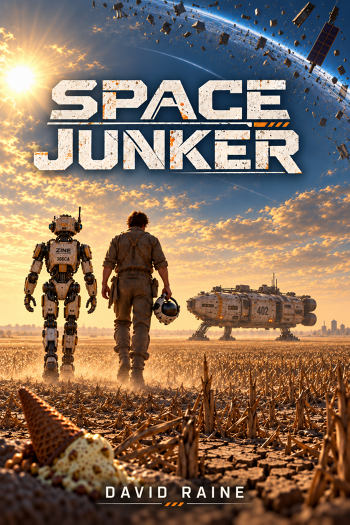
The absence of ice cream in Ashland, Illinois, is a small detail with a useful job. David Raine’s BookLife introduction uses it to make a damaged future feel like somewhere people actually live. Loss includes ordinary pleasures. A world can become frightening through the things its inhabitants can no longer take for granted.
Against that background, Bob deserves attention. He is an aging industrial robot kept working through repairs, carrying knowledge of a spacecraft buried beneath a collapsed barn. The ship belonged to Kyte Jacobs’s father. Before it becomes a way into danger, it is an inheritance that needs someone else’s memory to be understood.
That relationship is our reason for selecting Space Junker. A machine that outlives its makers can preserve a family connection as well as perform a task. The premise puts Kyte beside a companion whose history matters. It also makes technology feel used: maintained, repurposed and depended on by people with limited choices.
The launch material promises an adventure that moves from a drought-stricken Midwest into orbital wreckage. That is an appealing route for readers who want spacecraft and discovery without leaving the practical problems of survival behind. We recommend looking at this opening volume if you enjoy unlikely companions and futures built from leftovers. For discussion, ask what Kyte really inherits: the ship, his father’s unfinished business, or the obligation to decide what comes next.
Selection note based on the author’s BookLife introduction and October 3 launch announcement; a complete reading copy was not available for this feature.
BookLife book introduction ↗ · Author’s launch announcement ↗